AetherMesh
Decentralized Peer-to-Peer Agent Synchronization and State CRDTs for Autonomous Multi-Agent Systems
A formal architecture for epidemic gossip propagation and lightweight Byzantine fault tolerance at agent scale. Now with a reference implementation (v2.0.0).
Project
| Field | Value |
|---|---|
| Full title | AetherMesh: Decentralized Peer-to-Peer Agent Synchronization and State CRDTs for Autonomous Multi-Agent Systems |
| Version | 2.0.0 (Reference Implementation) / 1.0.0 (Formal Architecture) |
| Stage | Reference Implementation · Reproducible Experiments |
| License | MIT (code) · CC-BY-4.0 (docs, manuscript) |
| Domain | Distributed Systems / Software Engineering / Formal Methods |
| DOI (v2.0.0) | 10.5281/zenodo.24053492 |
| Concept DOI | 10.5281/zenodo.24038037 |
| OSF | 10.17605/OSF.IO/9PE5V |
| PyPI | aethermesh |
| Record ID | AETHERMESH-02 |
Central Question
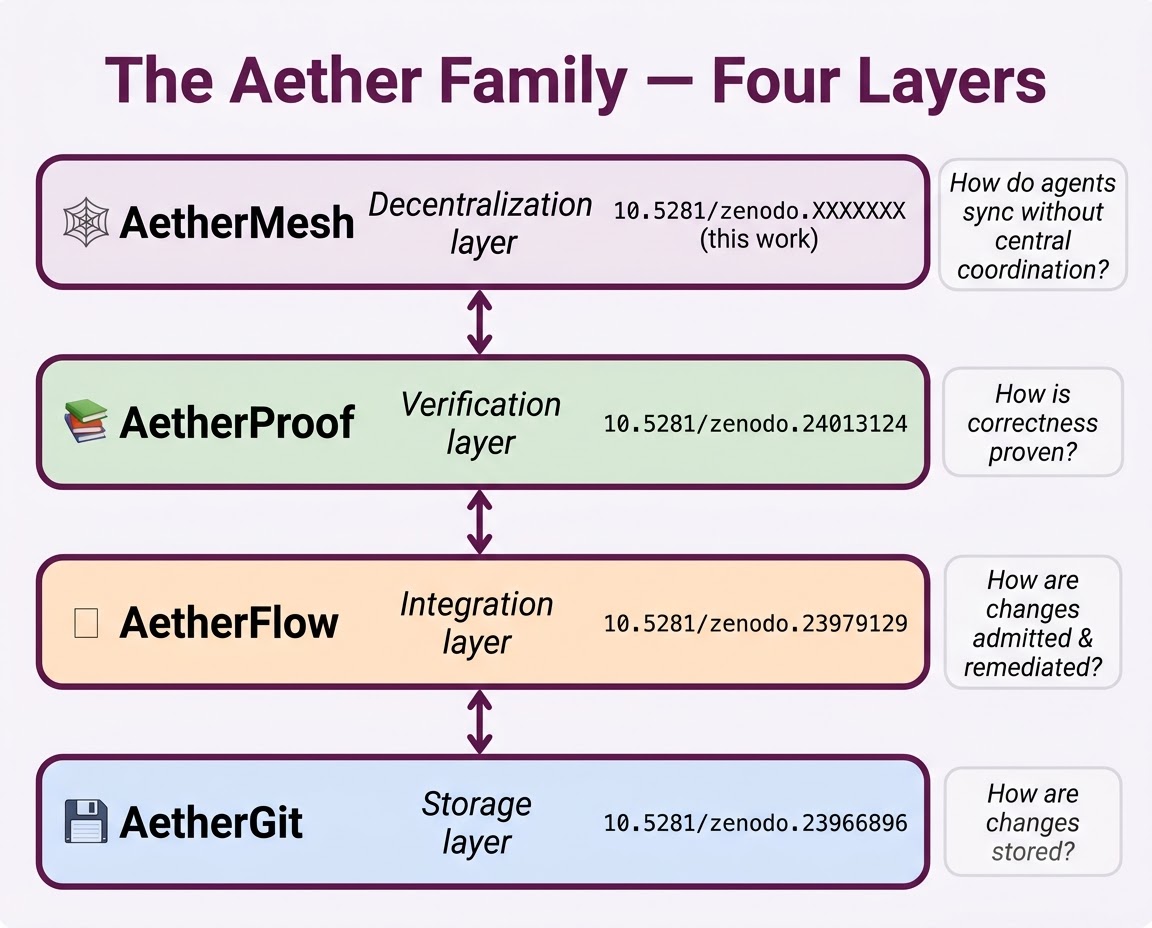
How can autonomous agents synchronize shared code and metadata without central coordination — combining concurrent changes, disseminating them, and deciding which received changes to trust — and under which explicit assumptions may the combined guarantees hold?
Formal Definitions
| Definition | Statement | Status |
|---|---|---|
| 1 — Convergent State Transition | R_a(t+1) = R_a(t) ⊔ ⨆_{m ∈ M_a} m | Defined |
| 2 — CRDT State Space | (S, ⊔, ⊥) bounded join-semilattice; s_reconciled = s_i ⊔ s_j | Defined |
| 3 — Gossip Infection Probability | P_uninfected(t) ≈ e^(−β·t) | Defined |
| 4 — Byzantine Admission Rule | Local verification of provenance, structure, and semantics before admission | Defined |
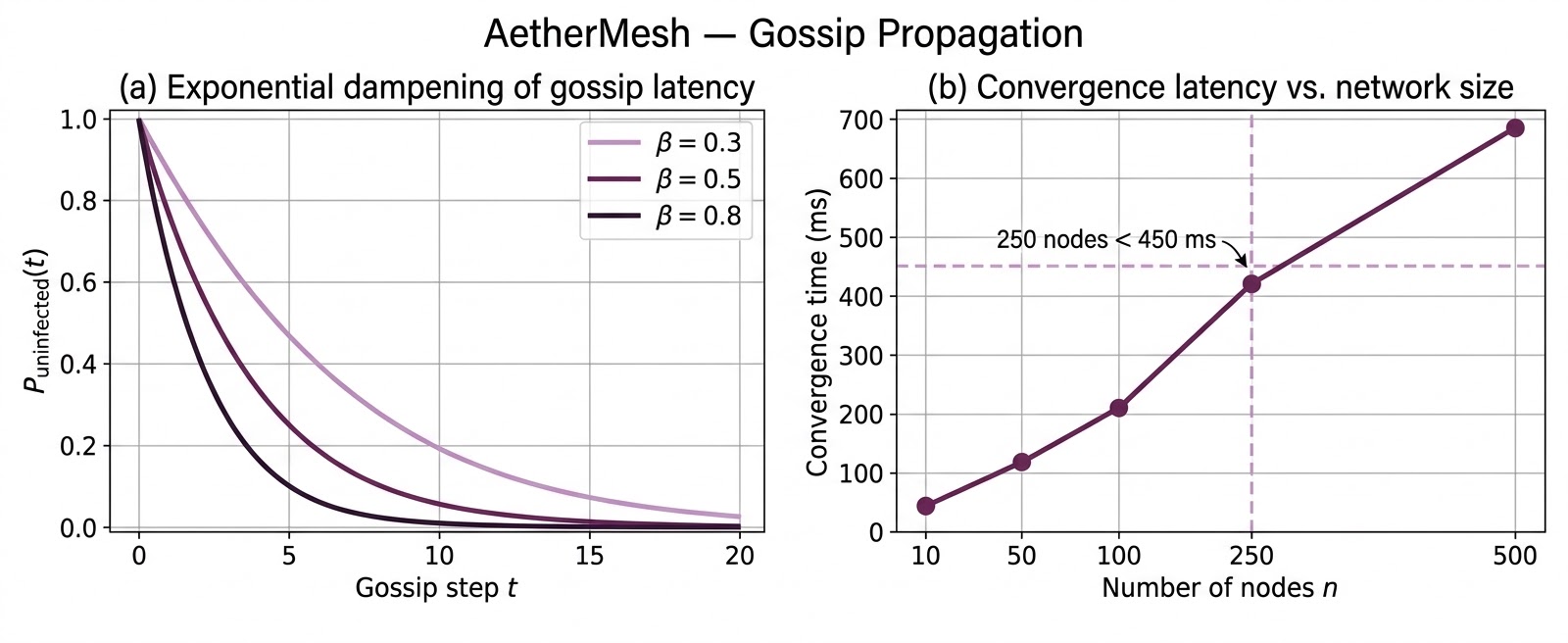
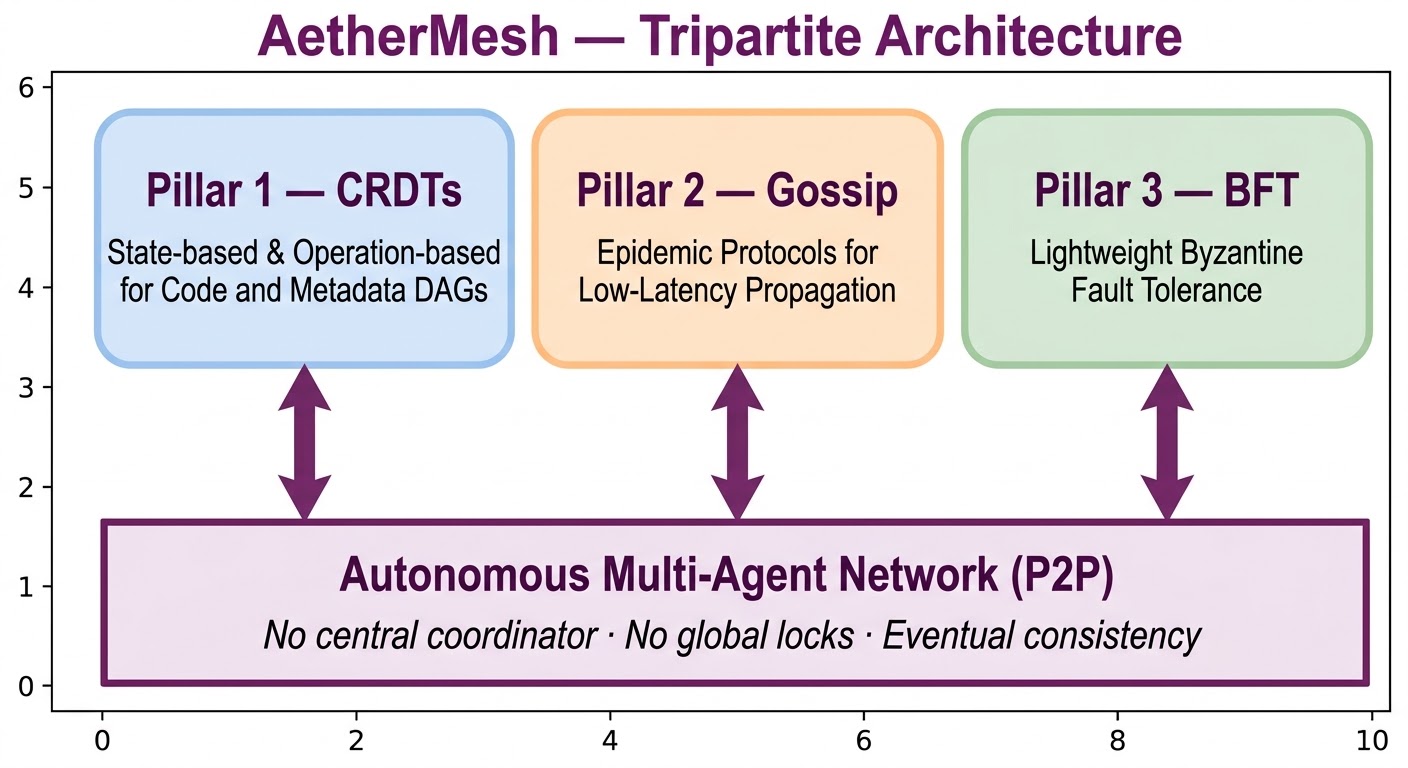
Figure 1 — The tripartite architecture of AetherMesh: CRDTs, gossip, and lightweight BFT sit above the peer-to-peer agent network.
Theorems
| # | Theorem | Status |
|---|---|---|
| T1 | Eventual Consistency (under A1–A6) | Proof sketch |
| T2 | Exponential Dampening of Gossip Latency (under A2) | Proof sketch |
| T3 | Byzantine Fault Tolerance Bound (under A5, A6) | Proof sketch |
Architectural Pillars
| Pillar | Status |
|---|---|
| 1 — CRDTs for Code and Metadata DAGs | Implemented |
| 2 — Epidemic Gossip Protocols | Implemented |
| 3 — Lightweight Byzantine Fault Tolerance | Implemented |
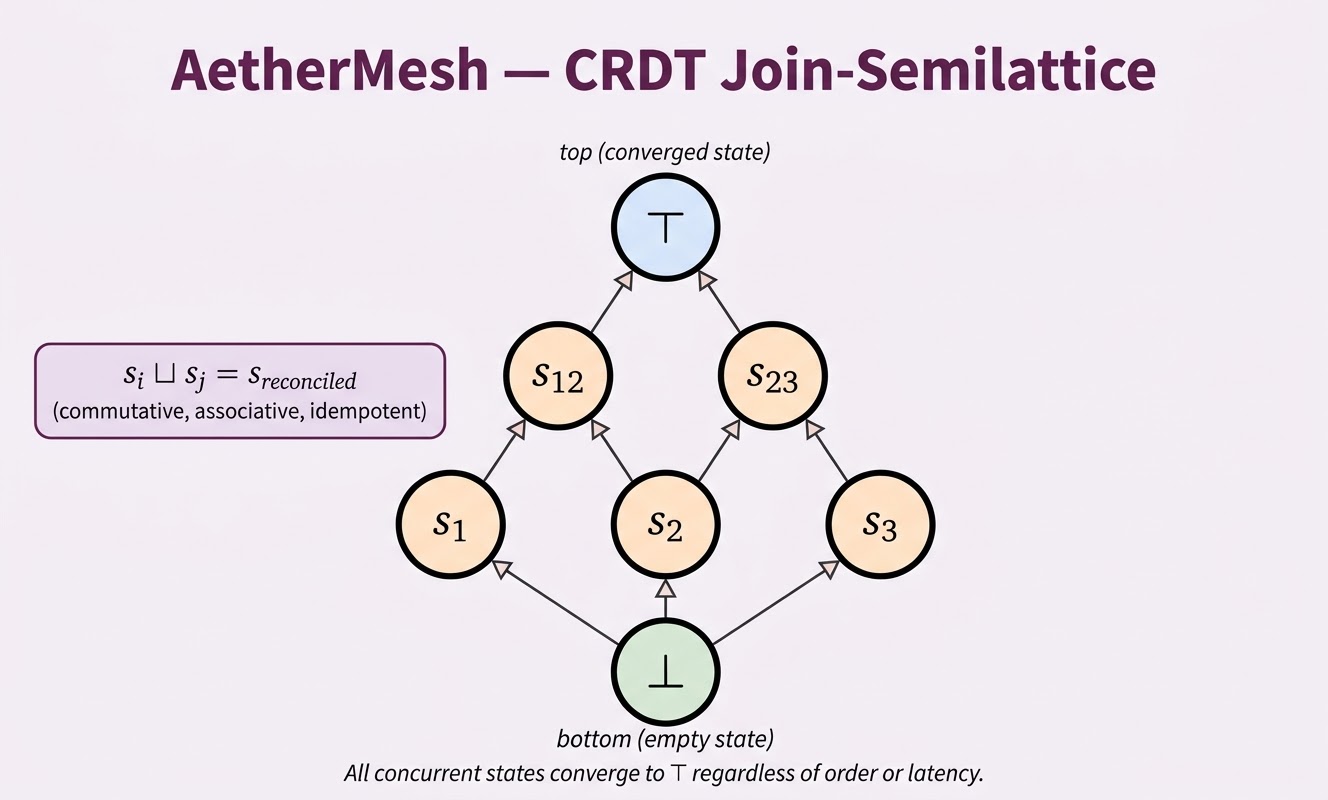
Figure 4 — A seven-element bounded join-semilattice as a Hasse diagram. The join laws were verified on this example by exhaustive enumeration.
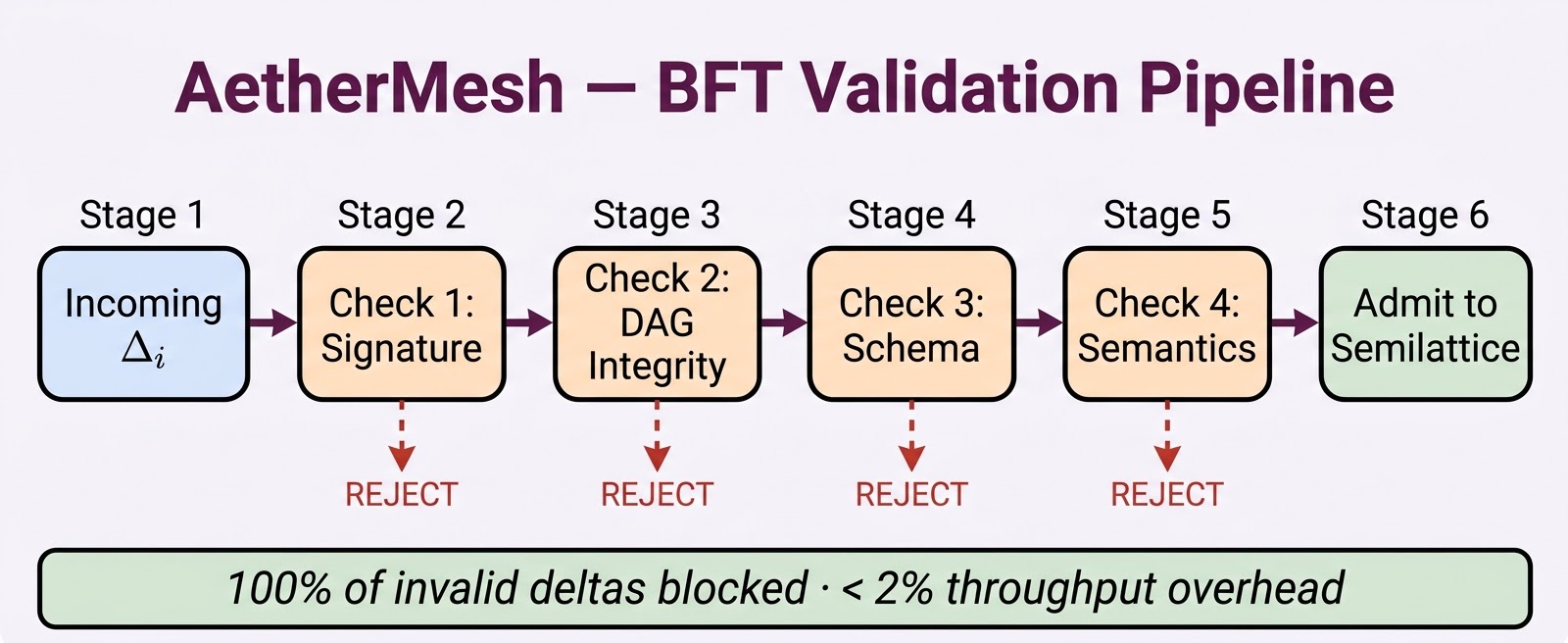
Figure 7 — A remote delta passes through signature, DAG-integrity, schema, and semantic-compatibility checks before joining the local semilattice.
Empirical Results (v2.0.0)
| # | Experiment | Result |
|---|---|---|
| 1 | Convergence Latency | Converged at 1–2 rounds (10–500 nodes) |
| 2 | Conflict Resolution | 0 deadlocks, 0 conflicts flagged |
| 3 | Fault Resilience | 100% block rate (10–500 malformed) |
Installation
pip install aethermesh==2.0.0Requires Python 3.9+. Runtime dependencies: numpy >= 1.24, cryptography >= 41.0.
Repositories and Archives
- GitHub Primary. Source code, issues, and pull requests. github.com/gitdeeper15/aethermesh
- PyPI Python package (2.0.0). pypi.org/project/aethermesh
- Zenodo (v2.0.0) Citable DOI for the reference implementation. doi.org/10.5281/zenodo.24053492
- Concept DOI Cite all versions (v1.0.0 + v2.0.0). doi.org/10.5281/zenodo.24038037
- OSF Registration Pre-registration and formal record. doi.org/10.17605/OSF.IO/9PE5V
- ORCID Researcher identity. orcid.org/0009-0003-8903-0029